Lucky7even Payment Methods Australia: Deposits, E-Wallets and Crypto
 Available in AU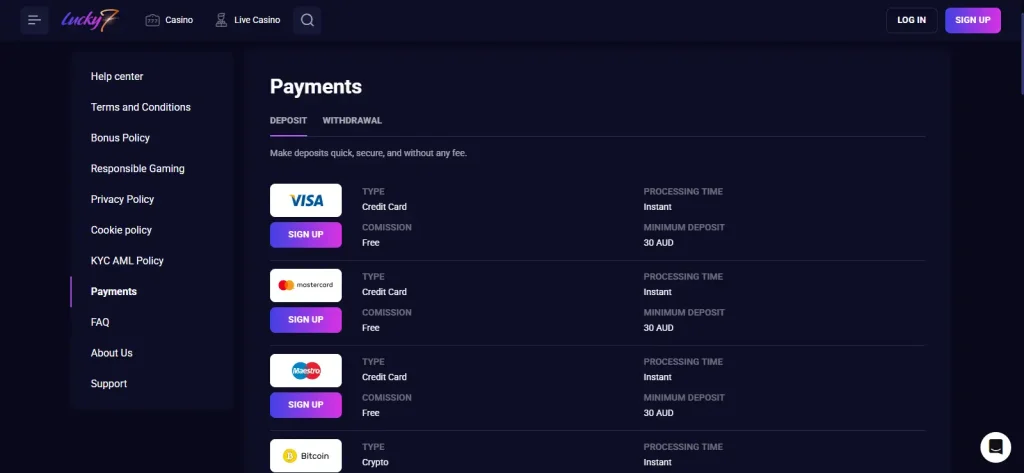
AU payment-method check – updated 21 September 2026
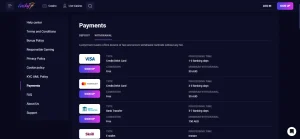
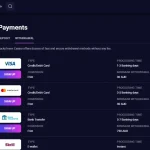
Lucky7even supports AUD, and its current English-AU payments page lists a broad mix of deposit methods including Visa, Mastercard, Maestro, Skrill, Neteller, MiFinity, MuchBetter, Neosurf, AstroPay, PayRetailers, Flexepin and multiple cryptocurrencies. The same public page groups withdrawals across cards, bank transfer, e-wallets and crypto. Those listings are useful for mapping the operator’s payment range, but they should not be read as a guarantee that every method will appear for every Australian account. Lucky7even’s Terms say payment convenience depends on jurisdiction, require deposits to come from an account in the player’s own name, and show method-specific limits when a method is selected. The logged-in cashier is therefore the practical place to verify account-specific availability before sending money.
Table of Contents
- Payment methods currently listed by Lucky7even
- AUD is supported, but the public table still shows mixed currencies
- Cryptocurrency support is broad
- Deposits must come from an account in your own name
- Withdrawal options are listed, but mechanics belong on the child pages
- Australian payment habits do not prove Lucky7even method availability
- Australian wagering credit rules are a separate legal issue
- Five checks before using a Lucky7even payment method
- How the public payments page differs from the cashier
- Payment-method summary
- Sources checked for this payment guide
Payment methods currently listed by Lucky7even
The AU-facing payment page presents several payment families rather than one preferred local method. Current verified listings include major cards, multiple e-wallets and prepaid or alternative options, alongside a substantial cryptocurrency set. For deposits, the current AU-facing listing includes Visa, Mastercard, Maestro, Skrill, Neteller, MiFinity, MuchBetter, Neosurf, AstroPay, PayRetailers and Flexepin, plus crypto methods.
| Payment family | Examples currently listed | How to interpret the public page |
|---|---|---|
| Cards | Visa, Mastercard, Maestro | Listed publicly, but bank and account acceptance still needs a live cashier check |
| E-wallets | Skrill, Neteller, MiFinity, MuchBetter | Useful alternatives where the account-specific cashier exposes them |
| Voucher and alternative methods | Neosurf, AstroPay, PayRetailers, Flexepin | Regional and provider availability can differ |
| Cryptocurrency | BTC, BCH, ETH, DOGE, LTC, USDT and other accepted currencies | Crypto support is listed, but Australian legal context must be considered separately |
| Withdrawals | Cards, bank transfer, e-wallets, crypto | Exact cashout method and limits belong in the withdrawal flow, not this overview |
This is deliberately a category map rather than a promise of checkout availability. The operator’s own Terms direct users to consider which methods are convenient in their jurisdiction, and payment processors or issuing banks can affect whether a transaction succeeds.
AUD is supported, but the public table still shows mixed currencies
Lucky7even’s Terms list AUD among accepted fiat currencies, and the English-AU site uses Australian-dollar localisation in relevant promotional areas. That makes AUD support a verified brand fact. The public payments table, however, currently displays some method minimums in EUR, CAD or USD even on the AU-localised page.
That mixed presentation is important because it prevents a simple assumption that every public minimum shown on the AU page is already an AUD-denominated account minimum. The Terms also state that the internal operating currency is EUR and that amounts in another currency can differ because of bank and processing-system conversion rates. This page does not convert those displayed thresholds into Australian dollars because the fact policy forbids unsourced currency conversions.
The practical rule is straightforward: use the public page to identify the payment families Lucky7even lists, then use the live cashier to read the currency and limit actually attached to the method in your account. If the cashier shows a different threshold from a static public table, the current account screen is the more relevant operational value.
Cryptocurrency support is broad
Lucky7even’s current Terms list BTC, BCH, ETH, DOGE, LTC, USDT, XRP, BNB, ADA and TRX among accepted cryptocurrencies. The AU payment page also visibly includes several crypto methods in its deposit and withdrawal tables. That is enough to describe crypto as a supported payment category without hedging.
Crypto support should still be separated from two other questions. First, a listed crypto currency does not establish that every network or coin will be offered to every account at all times. Second, the presence of crypto on Lucky7even’s site does not say anything by itself about Australian licensing or regulatory permission. Those are different facts.
For users comparing crypto with cards or e-wallets, the main decision point is not simply speed. It is also whether the chosen method appears in the logged-in cashier, whether the payment account belongs to the player, and whether later withdrawal or verification steps can be completed with the same identity and payment trail.
Deposits must come from an account in your own name
Lucky7even’s current Terms explicitly require deposits to come from a bank account, card, e-wallet or other payment account registered in the player’s own name. Third-party deposits are prohibited. This is a practical rule to check before choosing a method because using another person’s card or wallet can create problems that have nothing to do with the payment brand itself.
The same Terms tie withdrawal processing to identity verification. That is why a payment method should be evaluated as part of an account-verification chain rather than as a one-click deposit tool. A convenient deposit method is less useful if the ownership details cannot be matched later when a withdrawal is reviewed.
For the document side of that process, use the separate KYC checks guide. This payment overview keeps the focus on method categories and account ownership rather than duplicating the exact document and review rules.
Withdrawal options are listed, but mechanics belong on the child pages
The AU payments page lists withdrawal categories including cards, bank transfer, e-wallets and cryptocurrencies. That establishes the broad cashout channels. It does not mean every deposit method will necessarily be available as a withdrawal route for every account, and it does not make this parent page the right place to reproduce exact withdrawal limits or timing figures.
For cashout thresholds and method rules, use the dedicated withdrawal methods and limits guide. For processing targets and the difference between internal review and provider settlement time, use the withdrawal times guide. Keeping those topics separate makes the payment architecture clearer and reduces the risk that one stale number contaminates a general methods page.
As a pre-deposit check, it is still sensible to look at the withdrawal tab before funding the account. The question is not only “How can I deposit?” but also “What cashout routes are shown for my account if I later withdraw?” That is a practical comparison point even before exact limits are considered.
Australian payment habits do not prove Lucky7even method availability
The Reserve Bank of Australia’s 2025 Consumer Payments Survey shows that cards remained the most widely used consumer payment method in Australia, with debit cards accounting for about half of consumer payments. It also found increased mobile-wallet use and strong growth in PayID awareness and use.
That context helps explain why Australian users may expect cards, mobile wallets or account-to-account options when they visit an online cashier. It must not be turned into a Lucky7even claim. This site does not state that Lucky7even accepts PayID because the current verified Lucky7even fact set does not establish PayID as an account payment method.
The distinction is simple: RBA data describes how Australians pay generally; Lucky7even’s payment page and cashier describe what Lucky7even lists. A popular Australian payment method is not automatically a Lucky7even payment method.
Australian wagering credit rules are a separate legal issue
This distinction matters because the Lucky7even AU payments page currently lists both cards and cryptocurrency. The correct conclusion is not that one source cancels the other. They describe different things: Lucky7even publishes its own payment methods, while ACMA explains a statutory payment restriction for Australian wagering operators. The broader legal status of online casino services is covered separately.
For that regulatory context, see the Australian payment and gambling rules guide. This page does not infer local authorisation from the existence of an AU language version, AUD support or a payment method.
Five checks before using a Lucky7even payment method
- Check the logged-in cashier. Confirm that the method is actually offered to your account, not merely listed on a public information page.
- Read the displayed currency. The AU page contains mixed-currency minimums, so do not assume every threshold is already in AUD.
- Use a payment account in your own name. Lucky7even’s Terms prohibit third-party deposits.
- Check the withdrawal side as well. A convenient deposit route should be considered together with the cashout routes shown to the account.
- Keep product availability and legal status separate. A listed card, wallet or cryptocurrency is a brand payment fact, not proof of Australian regulatory approval.
This checklist is more durable than ranking one method as universally best. The best operational choice depends on what the current account shows, the currency and limits attached to the method, ownership of the payment account, and the withdrawal route that will later be available.
How the public payments page differs from the cashier
The public page is useful for discovery. It shows the families of methods Lucky7even supports and gives examples of processing labels and public minimums. It is also a marketing and information surface that can contain methods for more than one regional or processor context, as shown by the mixture of EUR, CAD and USD values on the English-AU table.
The logged-in cashier is account-specific. It is the sensible place to confirm what can actually be selected after the account, currency, location and payment-provider checks are applied. This does not require assuming that a hidden method is unavailable in every circumstance. It simply avoids treating a public catalogue as a guaranteed personal checkout screen.
For the same reason, this guide does not add PayID, a local bank, a wallet or a cryptocurrency merely because it would be common or convenient in Australia. The method has to be supported by the Lucky7even source set before it is written as a brand fact.
Payment-method summary
Lucky7even’s AU-facing payment information is broad: AUD is supported, the public deposit list includes cards, e-wallets, alternative methods and multiple cryptocurrencies, and the public withdrawal list covers cards, bank transfer, e-wallets and crypto. The strongest practical limitation is account specificity. A public listing does not guarantee that a particular bank, wallet or processor will be selectable for every Australian account.
The most useful way to compare methods is therefore to start with the public category map, verify the actual cashier, keep the payment account in the same name as the casino account, and check the withdrawal route before depositing. For the wider product assessment, return to the Australia review.
Sources checked for this payment guide
- Lucky7even English-AU Payments – current deposit and withdrawal method tables.
- Lucky7even Terms and Conditions – AUD and crypto currencies, jurisdiction-sensitive method guidance and own-name deposit rule.
- Reserve Bank of Australia 2025 Consumer Payments Survey summary – general Australian payment behaviour only.
- ACMA Credit Ban – current statutory context for credit cards and digital currency in Australian online and telephone wagering.