Lucky7even Complaints and Reputation: What Public Records Show
 Available in AU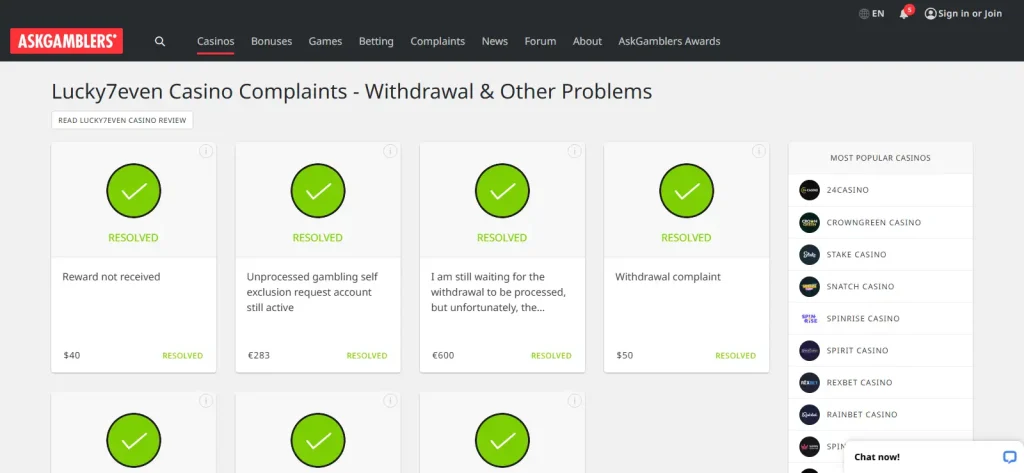
Complaint and review records – checked 21 September 2026
Lucky7even’s public reputation record is mixed because the sources measure different things. Structured complaint platforms show disputes about withdrawals, rewards, deposits, account closure and self-exclusion, while some of those cases are also recorded as resolved. Open-review platforms contain both strongly positive and strongly negative user reports. Separately, ACMA provides a regulator record: Lucky7even was named in an Australian ISP-blocking action on 19 March 2024, and no Lucky7even or Metlait match was found in the current Australian licensed-provider register. User reviews and complaint submissions are anecdotal samples, not representative performance data, so this page does not turn them into a claim about typical payout speed, complaint frequency or an overall “safe”, “unsafe”, “trusted” or “scam” verdict.
Table of Contents
- Three evidence classes should not be blended
- Regulator evidence comes first for Australia
- AskGamblers record: seven listed complaints, all shown as resolved
- Casino Guru record: a larger complaint set with multiple outcomes
- Trustpilot record: strongly polarised open-review sentiment
- Recurring complaint themes and the evidence behind them
- Why complaint platforms have selection bias
- How to read a Lucky7even complaint before relying on it
- Sources checked on 21 September 2026
- What the public record supports – and what it does not
Three evidence classes should not be blended
| Evidence class | What it can show | Main limitation |
|---|---|---|
| Regulator records | Dated enforcement, blocking actions and current licensed-provider register status. | They do not describe every customer interaction or every later domain. |
| Structured complaint platforms | Named dispute themes, status outcomes and public mediation history. | Submitters are self-selected and platform status rules differ. |
| Open consumer reviews | Broader positive and negative user sentiment at a point in time. | Review samples, moderation and scoring methods are not population-level performance measures. |
The practical rule is to give the strongest source the job it can actually perform. ACMA is the primary source for Australian regulatory history. AskGamblers and Casino Guru are useful for observing complaint cases. Trustpilot is useful for seeing an open-review distribution. None of the three categories should be silently converted into another.
Regulator evidence comes first for Australia
The strongest Australia-specific record is not a user review. ACMA’s 19 March 2024 notice named Lucky7even among gambling websites referred to Australian ISPs for blocking after investigations found services operating in breach of the Interactive Gambling Act. ACMA’s Jan-Mar 2024 enforcement report also recorded formal warnings to earlier operators Hollycorn N.V. and Libergos Limited in connection with Lucky7even and other brands.
Current status needs a separate check. ACMA’s licensed interactive gambling provider register, last updated 7 September 2026, returned no Lucky7even or Metlait match in the 21 September 2026 check. ACMA’s Apr-Jun 2026 enforcement report names current operator Metlait S.R.L in relation to Spinrise and Lucky Vibe, not Lucky7even. The detailed chronology and provider-side law are explained on the ACMA and Australian law page.
This regulator evidence should not be softened or intensified by review-site sentiment. A positive review cannot create an Australian licence. A negative review cannot create a new ACMA enforcement action. The current licence and operator page handles the foreign licence chain and local-register result separately.
AskGamblers record: seven listed complaints, all shown as resolved
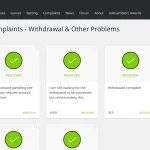
On the Lucky7even complaints page checked on 21 September 2026, AskGamblers displayed seven complaint entries, each carrying a resolved status. The visible subjects span a missing reward, an unprocessed self-exclusion request, a pending withdrawal, another withdrawal dispute, a complaint labelled by the submitter as being “scammed”, a tournament payout dispute and a deposit that was not credited.
The status matters because simply counting complaint titles without outcomes would omit part of the record. One 2026 self-exclusion case ended with the complainant confirming receipt of a EUR 283 refund for deposits made after an earlier closure request, and AskGamblers closed the case as resolved. A separate withdrawal complaint ended with the player confirming that a disputed USD 50 payment was received, although the user remained critical of the delay and handling.
Those examples show why complaint content should be read at case level. They document that specific disputes occurred and that the platform recorded specific resolutions. They do not establish that every self-exclusion request is handled the same way, that all delayed withdrawals eventually resolve, or that the platform’s seven visible cases represent the full population of Lucky7even users.
For the contractual mechanics behind cashouts, use the withdrawal rules page. For the difference between operator processing, method labels and user-perceived delay, use the withdrawal timing. Complaint anecdotes are not substituted for those first-party terms.
Casino Guru record: a larger complaint set with multiple outcomes
Casino Guru’s current Lucky7even review surface presents a different complaint dataset and a different classification method. In the complaint module checked during this session, it showed 49 complaints in total: 1 opened, 0 unresolved, 12 resolved and 36 rejected. The visible themes include account reopening, withdrawal caps, account closure, confiscated winnings, bonus disputes and delayed withdrawals.
That larger count should not be merged mathematically with AskGamblers. The sites collect cases differently, apply different acceptance and rejection criteria, and may include different periods or related-case logic. Adding their counts together would create a synthetic complaint total that neither platform publishes.
There is another reason to read platform methodology before relying on a headline. Casino Guru’s review narrative says it found no “relevant” complaints for its own Safety Index assessment, while the same page’s complaint module lists the 49 cases and their statuses. That is a platform-specific classification choice, not a contradiction that this site resolves by inventing its own score. It demonstrates that a raw case count and a platform’s weighted relevance assessment are different metrics.
A recently opened case on the platform concerned an allegation that an account previously closed because of gambling problems was reopened and losses followed. At the check date, that case was open and awaiting further process. An open allegation should remain an allegation; it is not a final finding.
Trustpilot record: strongly polarised open-review sentiment
The Trustpilot profile checked on 21 September 2026 showed 133 reviews. Its distribution was heavily polarised: 69% of reviews were one-star and 23% were five-star, with smaller shares at the middle ratings. The page also showed 30 reviews in the previous 12 months and said the company had replied to 100% of negative reviews, typically within two weeks.
Those figures are useful as a point-in-time view of that platform, not as a statistical failure rate. Trustpilot itself says the company had no recent history of asking for reviews and warns that the reviews may not be representative. The platform also explains that reviews are the opinions of individual users. A review distribution therefore describes the people who posted there after Trustpilot’s moderation process; it does not tell us how many total Lucky7even customers existed, how many had no issue, or how many experienced each complaint type.
The same limitation applies in the other direction. Positive reviews can describe smooth payouts, helpful support or an enjoyable product experience, but they do not negate a documented complaint or a regulator action. Negative reviews can describe frustrating disputes, but they do not prove that the same outcome is typical for every customer.
Recurring complaint themes and the evidence behind them
Withdrawal delay and payment disputes
Delayed or disputed withdrawals appear across public complaint surfaces. That establishes a recurring topic in submitted cases, not a measured average payout time. Lucky7even’s own withdrawal terms and payment table are better sources for the formal limits and method labels, while complaint cases show how some users say the process played out in practice.
Bonus and reward disputes
Complaint titles include missing rewards, payout limitations and winnings affected by bonus rules. The correct way to investigate those disputes is to compare the specific promotion, wagering rule and max-cashout condition that applied at the time. A complaint title alone cannot establish whether a contractual rule was correctly applied in another account.
Account closure and self-exclusion
Both AskGamblers and Casino Guru show cases involving account closure or self-exclusion concerns. Some cases are shown as resolved, while a more recent Casino Guru case was still open at the check date. Because responsible-gambling disputes can involve timing, prior communications and account history, a single case should not be generalised into a universal process claim.
Why complaint platforms have selection bias
People who file formal complaints are not a random sample of all users. They are more likely to have experienced a problem serious enough to seek outside mediation. Open review sites can have the opposite and additional biases: very satisfied and very dissatisfied users can be more motivated to post, review invitations can change who participates, duplicate or manipulated submissions can require moderation, and different sites apply different verification systems.
The missing denominator is critical. A list of 7, 49 or 133 records says how many items a platform displays under its own rules. Without a reliable total number of customers, withdrawals, support contacts or self-exclusion requests for the same period, those counts cannot be converted into a complaint rate, payout failure rate or probability that a new user will have the same experience.
Time also matters. A resolved 2024 withdrawal dispute, a 2026 self-exclusion complaint and a recent Trustpilot review do not describe the same operator moment or the same account conditions. Reputation analysis is stronger when dates and status outcomes stay attached to each item rather than being collapsed into a timeless label.
How to read a Lucky7even complaint before relying on it
- Check the date. Older cases can refer to earlier operators, earlier terms or payment methods that have changed.
- Check the status. Open, resolved, rejected and unresolved cases are materially different outcomes.
- Separate the allegation from the platform’s final status or the casino’s response.
- Identify the issue type. A bonus dispute, self-exclusion case and bank-transfer delay require different source documents.
- Compare the case with current first-party terms rather than assuming the complaint text itself states the governing rule.
- For Australian regulatory questions, return to ACMA rather than treating a review site as a regulator.
This method is more informative than counting stars alone. It also reduces the risk of cherry-picking only negative or only positive examples.
Sources checked on 21 September 2026
- AskGamblers Lucky7even complaints: structured complaint list with visible case statuses.
- Casino Guru Lucky7even review and complaint module: complaint counts, statuses and platform-specific review methodology.
- Trustpilot Lucky7even profile: open consumer-review distribution and platform representativeness notice.
- ACMA 19 March 2024 notice: regulator evidence for the historical Lucky7even blocking action.
These sources are intentionally not averaged into one score. Their populations, purposes and moderation systems are different.
What the public record supports – and what it does not
The public record supports saying that Lucky7even has documented Australian regulatory history and a visible body of user complaints and reviews. It also supports saying that some structured complaints have been resolved, while other platforms show rejected or currently open cases. It supports describing specific themes with attribution.
It does not support a universal conclusion about how every withdrawal, bonus or self-exclusion request is handled. It does not provide a defensible complaint rate because the number of total customers and transactions is unknown. It does not justify turning a third-party score into this site’s score, and it does not change the current Australian register result.
The useful takeaway is methodological: read regulator records as regulator evidence, complaint cases as case evidence and open reviews as sentiment evidence. Then check the underlying terms for the issue that matters to you. Return to the Lucky7even review for the complete product context rather than treating reputation data as a substitute for the rest of the site.